Results
Displaying 1111 - 1120 of 6844
Title |
Author | Citation | Agency Citation | Summary | Type |
|---|---|---|---|---|---|
| Canada - Yukon Statutes. Animal Protection Act | R.S.Y. 2002, c. 6, s. 1 - 14 | This set of laws comprises the Yukon, Canada Animal Protection Act. The Act provides that no person shall cause or allow an animal to be in distress. Any person who contravenes this Act is guilty of an offence and liable on summary conviction to a fine of not more than $500 and, in default of payment, to imprisonment up to six months, or to both fine and imprisonment. A judge may also prohibit a person convicted of an offence under the Act from owning an animal or from having charge of an animal for any specified time period. The Act also outlines the power of peace officers to seize animals in distress as well as those powers of humane societies to provide care for such animals. | Statute | ||
| Canada Migratory Birds Convention Act, 1994 | TS 628 | Per Digest of Federal Resource Laws of Interest to the U.S. Fish and Wildlife Service: This 1916 treaty adopted a uniform system of protection for certain species of birds which migrate between the United States and Canada, in order to assure the preservation of species either harmless or beneficial to man. Sets certain dates for closed seasons on migratory birds. Prohibits hunting insectivorous birds, but allows killing of birds under permit when injurious to agriculture. The Convention was signed at Washington, D.C., on August 16, 1916, and ratified by the United States on September 1, 1916, and by Great Britain on October 20, 1916. Documents of ratification were exchanged on December 7, 1916. Implementing legislation for the United States was accomplished by enactment of the Migratory Bird Treaty Act in 1918 (16 USC 703-711; 40 Stat. 755). Canada and the United States signed an agreement on January 30, 1979, to amend the treaty to allow subsistence hunting of waterfowl outside of the normal hunting season, but it was never ratified by the Senate and never took effect. The treaty was amended in 1995 to establish a legal framework for the subsistence take of birds in Alaska and northern Canada by Alaska Natives and Aboriginal people in Canada. The Senate provided its advice and consent to the amendments in November, 1997. The treaty was formally implemented in 1999. | Treaty | ||
| Canada's Anti-Cruelty Laws | Jessica Pask |
Brief Summary of Canada's Anti-Cruelty Laws |
Topical Introduction | ||
| Canada's Dangerous Dog Law | Jacquelyn Shaw |
Brief Summary of Canada's Dangerous Dog Laws
|
Topical Introduction | ||
| Canada's Legal System in a Nutshell | Jacquelyn A. Shaw | Animal Legal & Historical Center |
This document gives a brief summary of the structure of the Canadian legal system. |
Article | |
| Canadian Animal Anti-Cruelty Legislation | Charles Hall | Animal Legal & Historical Center |
This paper examines the substance and history of animal anti-cruelty law in Canada. In doing so, it discusses the controversy surrounding the last amendments to the existing law (Bill C-50) introduced in parliament last year. |
Article | |
| Canadian Animal Law | Annie Belanger | Animal Legal & Historical Center |
This article sets out for the reader how to research the full variety of animal issues for the Canadian legal system, with a focus on Ontario. |
Article | |
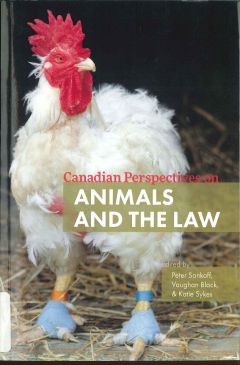
| Canadian Perspectives on Animals and the Law |
|
Policy | |||
| Canaries as subjects of rights - Argentina DO NOT PUBLISH YET | Case | ||||
| Canned Hunts: The Other Side of the Fence | Fund for Animals | http://fund.org/library/documentViewer.asp?ID=42&table=documents |
This article, reprinted with permission from The Fund for Animals' website, explains the activity referred to as 'canned hunting.' |
Article |