
Results
Title |
Author | Citation | Alternate Citation | Summary | Type |
|---|---|---|---|---|---|
| Gill v. Brown | 695 P.2d 1276 (Idaho App., 1985) |
Plaintiffs sought to recover property damages and damage and for mental anguish sustained when Brown allegedly shot and killed a donkey owned by the Gills. By alleging that Brown's conduct was reckless and that they thereby suffered extreme mental anguish and trauma, the court held that the Gills have alleged facts that, if proven, could permit recovery under an intentional infliction of emotional distress cause of action. Accordingly, the court held that the district court erred by striking the Gills' claim for damages caused by mental anguish and the cause was remanded. |
Case | ||
| Gill v. Prehistoric Ponds, Inc. | 634 S.E.2d 769 (Ga.App., 2006) | 2006 WL 1550709 (Ga.App.), 280 Ga.App. 629 (2006) |
In this Georgia case, the Court of Appeals held that, on issue of first impression, an alligator farm was not a "farm" within meaning of the state statute that exempted "farm laborers" or their employers from coverage under the Workers' Compensation Act (Gill was bitten while cleaning out a pen and subsequently developed both a bone infection and salmonella). In construing the relevant statutes, the court found that in the chapter on Employment Security Law (ESL), the legislature meant that individuals who raise or tend wildlife perform "agricultural labor," but only when they do so on a "farm," which is "used for production of stock, dairy products, poultry, fruit, and fur-bearing animals." Accordingly, the court concluded that when Gill cleaned out the alligator pens, he was caring for wildlife and thus performing "agricultural labor." However, his employer, an alligator farm, was not a "farm" because alligators are "wildlife," not "[live]stock ... [or] fur-bearing animals." |
Case | |
| Gilman v. Nevada State Board of Veterinary Medical Examiners | 89 P.3d 1000 (Nev. 2004) | 2004 WL 1109610 (Nev.), 120 Nev. 263 (2004) |
The Slensky's took their ill beagle to Defendant's Animal Hospital for routine vaccinations and examinations due to the dog's loose stools for four days. X-rays of the dog were taken, and when the dog was returned to the Slensky's, where it then collapsed. Defendant instructed them to take the dog to the emergency clinic, where it later died. The family filed a complaint with the Nevada State Board of Veterinary Medical Examiners, and Defendant was later convicted of gross negligence and incompetence, an ethics violation, and for using an unlicensed veterinary technician. His license was suspended and he was placed on probation. The Court held that Defendant: (1) could be assessed costs of the proceeding; (2) he could not be assessed attorney's fees; (3) the Board could award expert witness fees above the statutory cap; (4) the Board failed to justify the imposition of costs for an investigator; and (5) statutes did not permit the employment of an unlicensed veterinary technician. |
Case | |
| Gilreath v. Smith | 797 S.E.2d 177 (Ga. Ct. App., 2017) | 340 Ga. App. 265, 2017 WL 660590 (Ga. Ct. App., 2017) |
While pet sitting for Defendants Bruce and Jodi Smith, Plaintiff Josephine Gilreath was attacked and injured by the Smiths' rooster, which caused a serious infection with long-term consequences. Plaintiff Gilreath filed suit, but the trial court granted summary judgment in favor of the Defendants on the ground that Gilreath assumed the risk. Gilreath appealed to the Court of Appeals of Georgia. The Court of Appeals affirmed the trial court and reasoned that Gilreath assumed the risk of injury based on the state statutes of owners of land under OCGA § 51-3-1, as keepers of a vicious or dangerous animal under OCGA § 51-2-7, and as required by a Roswell city ordinance. The Court reasoned that at prior pet-sittings at the Defendants home, Gilreath had been warned that the rooster would attack and that a garbage can lid was useful for controlling the rooster. Second, Gilreath has not raised an issue of fact regarding whether the Smiths had superior knowledge of the risks associated with the danger. Gilreath, a professional pet sitter with at least nine years of experience, admitted that she had a responsibility to educate herself about the animals she takes care of yet she failed to do so for roosters. Third, Gilreath admitted that she chose to take the job knowing that she had been told that the rooster would attack. Gilreath also contends that the Smiths violated a Roswell city ordinance, but she failed to introduce a certified copy of the ordinance and thus failed to prove this claim. |
Case | |
| GIVING SLAUGHTERHOUSES GLASS WALLS: A NEW DIRECTION IN FOOD LABELING AND ANIMAL WELFARE | Zak Franklin | 21 Animal L. 285 (2015) | Modern industrial animal agriculture and consumer purchasing patterns do not match consumers' moral preferences regarding animal welfare. Current production methods inflict a great deal of harm on animals despite widespread consumer preference for meat, dairy, and eggs that come from humanely treated animals. Judging by the premium pricing and market shares of food products with moral or special labels (e.g., 'cage-free," 'free range,' and 'organic'), many consumers are willing to pay more for less harmful products, but they are unable to determine which products match this preference. The labels placed on animal products, and the insufficient government oversight of these labels, are significant factors in consumer ignorance because producers are allowed to use misleading labels and thwart consumers from aligning their preferences with their purchases. Producers are allowed to label their goods as friendly to animals or the environment without taking action to conform to those claims. Meanwhile, producers who do invest resources into more humane or environmentally-conscious production methods are competing with companies that do not make similar expenditures. Those companies can sell their products at a lower price without sacrificing profits, which prices-out producers who do invest resources. This Article proposes a new labeling regime in which animal products feature labels that adequately inform consumers of agricultural practices so that consumers can match their purchases with their moral preferences. In this proposed scheme, animal products would contain a label that concisely and objectively informs consumers what practices went into the making of that item. Such a scheme would enable consumers who wish to pay more for humane or environmentally-friendly products to do so, while rewarding those companies who actually do engage in better production methods. While the legal literature discussing food labeling and animal welfare is growing, most of the literature proposes legal definitions of terms like 'humane,' expansion of consumer protection law, or labeling systems in which third-parties provide grading or ranking systems for producers of animal products. This Article rejects those proposals as inadequate to sufficiently inform consumers and instead suggests providing consumers with a list of select practices producers engage in. | Article | |
| Global Animal Law Conference III |
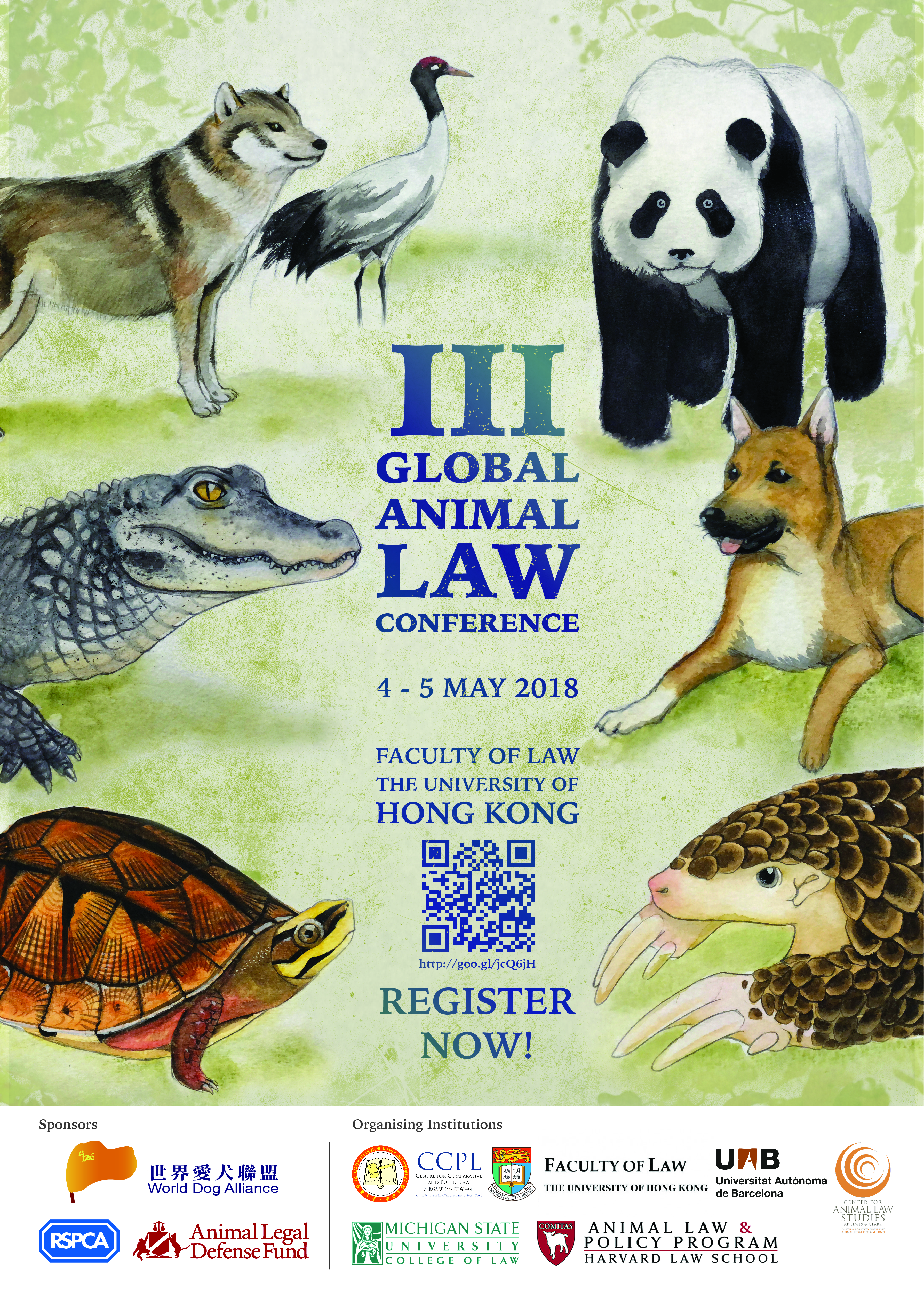 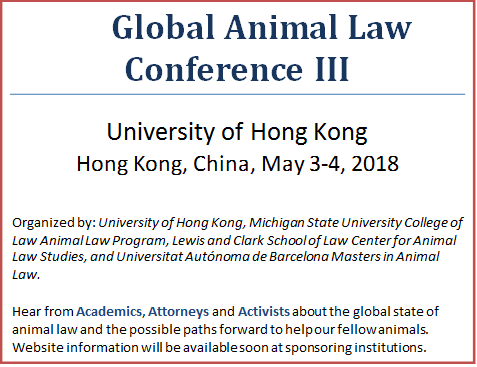 |
Basic page | |||
| Global Journal of Animal Law |
Global Journal of Animal LawFor more information about the Journal, see http://gjal.abo.fi/ |
Policy | |||
| Glover v. Weber | Glover v. Weber,183 Wash.App. 1044 (Wash. Ct. App. Oct. 6, 2014) | 2014 WL 4988156 (Wash. Ct. App. Oct. 6, 2014) |
In this case, Sylvia Weber filed suit against Monika Glover for injuries sustained when Weber’s daughter fell off a horse owned by a third party and boarded on Glover’s land. The trial court granted summary judgment in favor of Weber. Glover appealed the trial court’s decision, arguing that she was immune from liability under the Equine Activities statute. The court of appeals reviewed the issue and reversed the trial courts decision and granted summary judgment in favor of Glover. The main issue of the case whether or not Glover fell under the definition of “equine activity sponsor” provided in the act. Weber argued that Glover was not an “equine activity sponsor” because she was not participating in a public or group-based equine activity or a professional equine activity. The court of appeals disagreed with Weber’s argument and determined that noting in the plain language of the statute requires the equine activity to be public or group-based or professional to be covered under the statute. For this reason, the court of appeals found that Glover was considered a “equine activity sponsor” under the act and was therefore immune from liability. |
Case | |
| Gluckman v. American Airlines, Inc. | 844 F.Supp. (151 S.D.N.Y., 1994) |
Plaintiff sued American Airlines for emotional distress damages, inter alia , after his dog suffered a fatal heatstroke while being transported in the cargo hold of defendant's airliner (the temperature reached 140 degrees Fahrenheit in violation of the airline's cargo hold guidelines). Plaintiff relied on the state case of Brousseau v. Rosenthal and Corso v. Crawford Dog and Cat Hosp., Inc in support of his negligent infliction of emotional distress claim. The court observed that none of the decisions cited by plaintiff, including Corso, recognize an independent cause of action for loss of companionship, but rather, they provide a means for assessing the "intrinsic" value of the lost pet when the market value cannot be determined. As a result, the court rejected plaintiff's claim for loss of companionship as well as pain and suffering without any prior authority that established the validity of such claims. |
Case | ||
| Goldberger v. State Farm Fire and Casaulty Company | --- P.3d ----, 2019 WL 3792803 (Ariz. Ct. App. Aug. 13, 2019) | Joel and Kim Goldberger owned residential rental property in Flagstaff that was insured by State Farm Fire and Casualty Company under a rental dwelling policy. The Goldbergers filed a claim asserting that their tenant allowed feral cats to access the property and cause approximately $75,000 in “accidental damage.” State farm subsequently denied the claim asserting that feral cats are domestic animals and therefore the damage was not covered under the policy. The Goldbergers filed suit alleging breach of contract and insurance bad faith. State Farm moved to dismiss the complaint for failure to state a claim. State Farm claimed that the policy stated that accidental losses caused by “birds, vermin, rodents, insects, or domestic animals” were not covered by the policy. The superior court granted State Farm’s motion and this appeal followed. The Goldbergers argued that the superior court erred in dismissing their complaint due to the fact that the term “domestic animals” is reasonably susceptible to differing interpretations and must be construed against State Farm. State Farm argued that the exclusion in the policy was only susceptible to one reasonable interpretation. The Court stated that there were two interpretations to the term “domestic animal.” The first definition is a species-based definition that says that domestic animals are animals belonging to a broader class of animals that have been domesticated at some point in history. The second definition is an individualized definition that says that domestic animals are animals that are kept by a person for any of various purposes, including as pets. The Court ultimately decided that the individualized definition makes more sense in terms of the insurance policy itself as well as case law. In making this determination, the court noted the "nonsensical" outcome that would arise for exotic or nontraditional pets were a species-based definition adopted. Domestic animals encompass animals that are subject to the care, custody, and control of a person. On the facts alleged in the complaint alone, the Court could not say that the tenant was keeping the feral cats in such a manner that the exclusion would preclude coverage. The court therefore resolved all reasonable inferences in the Goldberger’s favor and presumed that the cats were feral. Because the feral cats that caused the damage are not domestic animals under all reasonable interpretations of the facts alleged in the complaint, the court erred in granting the insurer's motion to dismiss. The Court reversed the superior court’s order dismissing the Goldberger’s complaint and remanded for further proceedings consistent with the opinion. | Case |